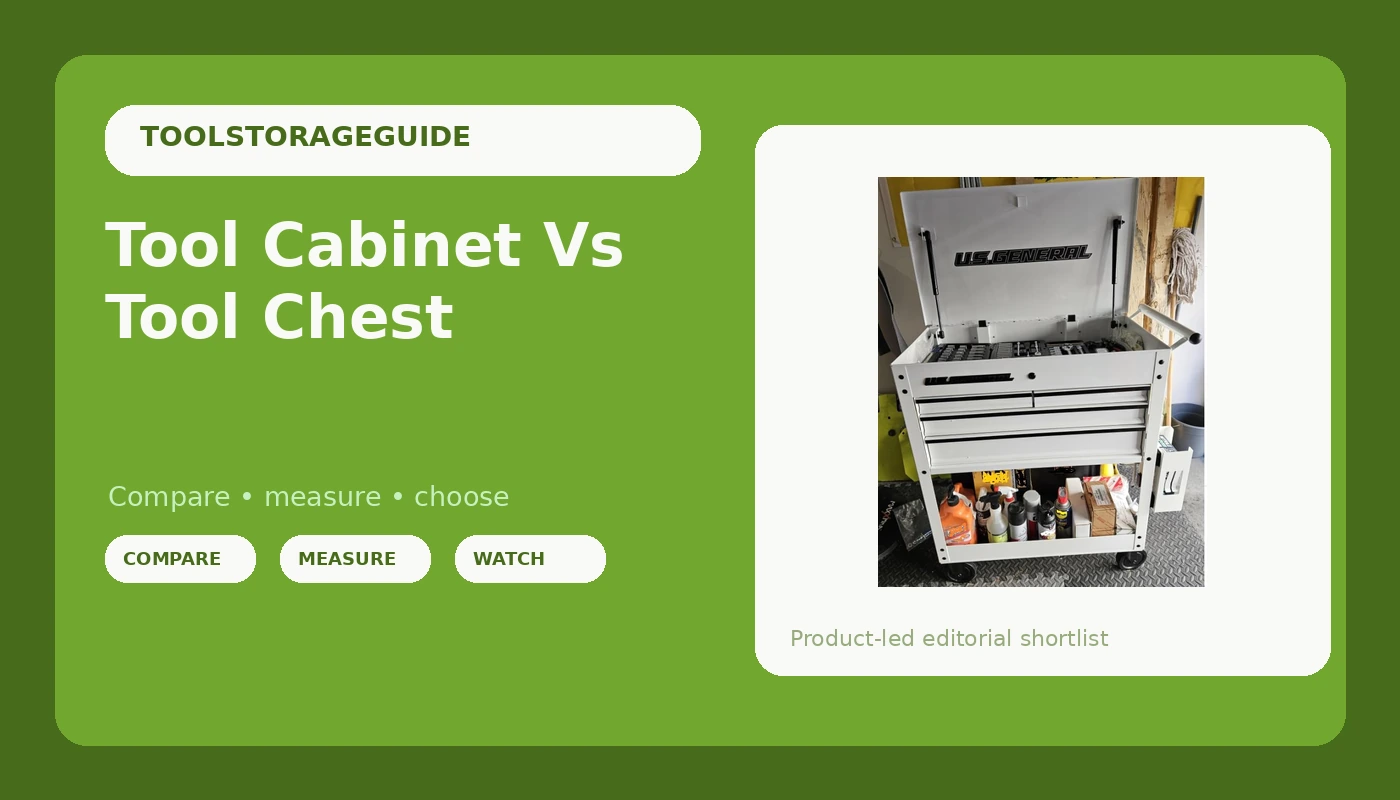
I've got a 44" US General in my garage that's held up for two years, and a used Snap-on KRL that cost me ~$2,200 and still feels like the day it left the factory. I've also got a Craftsman stack in the corner that my dad handed down, and the slides died at 18 months.
So when someone asks me whether they should buy a tool cabinet or a tool chest, I don't give them a marketing answer.
I give them the answer that comes from loading, slamming, and living with both.
The tool chest wins for most home mechanics, because it gives you more usable drawer space per square foot of floor, and the casters let you roll it to the job instead of walking back and forth. A tool cabinet only wins if you've got a permanent workbench spot and you're tired of bending over.
Here's the short version before I get into the weeds:
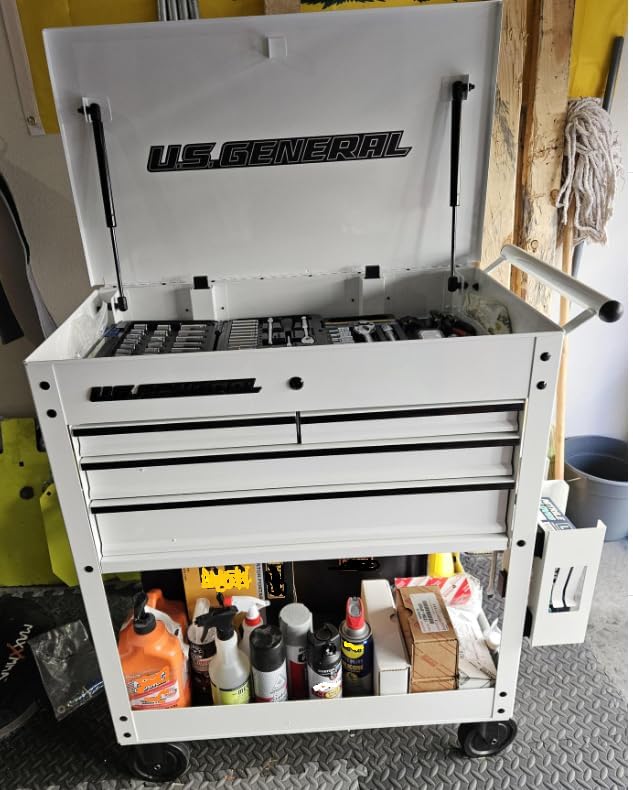
U.S. General 30 in. 4-Drawer Tech Cart, White
More drawers, more visible layout, rolls to the job
Visit on Amazon →U.S. General 30 in. Tool Chest 4-Drawer Tech Cart, White
Better for a fixed workspace, holds heavier stuff lower
Visit on Amazon →Tool Chest Pros:
- Drawers pull out and you can see everything at once
- Rolls to the job, which saves your back
- Better for organizing by tool type, not by project
Tool Chest Cons:
- Top is thin, you'll want a plywood sheet
- Casters are the weak point on budget models
- Top drawers become junk drawers unless you're disciplined
Tool Cabinet Pros:
- Lower center of gravity, holds heavy stuff better
- Fixed position means it doesn't move around on you
- Usually cheaper per cubic inch of storage
Tool Cabinet Cons:
- You walk to it, it doesn't come to you
- Less drawer space, more shelf space you have to dig through
- Harder to reorganize once it's in place
Compared to
The real question isn't chest vs cabinet in a vacuum. It's what you're doing with it.
A tool chest like the US General 44" gives you eight drawers of varying depths, and you can see every socket and driver the moment you pull a drawer open. I've got mine loaded with impact drivers, a torque wrench, and about 80 pounds of mixed sockets.
The slides are genuinely smooth, even after two years of daily abuse. Gus, my 75-pound lab, leans on the bottom drawer when he's waiting for me to finish a job, and it still glides like it's new.
A tool cabinet, like the Husky 52" combo, is a different beast. It's got a work surface on top, which is nice, but the drawers are shallower and you end up stacking things vertically. I've seen guys organize a cabinet by project, which works if you're a weekend warrior who does one job at a time.
But if you're like me, and you've got three jobs going at once, you'll be digging through the bottom shelf for the 21mm socket while your brake job sits half-finished.
Design
The tool chest wins on layout. Period. Drawers pull out, you see everything, you grab what you need, and you move on. The US General 44" has a drawer layout that makes sense: shallow drawers on top for sockets and drivers, deeper drawers on the bottom for impact guns and the heavy stuff. That's how a box should be organized.
The tool cabinet is a different philosophy. It's built for a fixed position, so you're not rolling it around. The Husky 52" combo at $598–$698 is the best bang for the buck if you catch it at the right price, but the slides are meh.
They're ball-bearing, sure, but they don't have the smoothness of the US General. I've had friends describe the Husky slides as "fine," which is the most damning word in tool storage.
Fine means they work, but you don't notice them. Fine means you're not impressed, but you're not angry either.
The steel gauge matters too. The US General is 22-gauge, which is thin. The corners will dent if you drop a 3/4" socket on them. The Husky is similar. Neither of these boxes is a Snap-on, and you shouldn't expect them to be. But the US General's thin top is a real problem. I put a 3/4" plywood sheet on mine within a week of buying it, and that's the best ~$20 upgrade you can make to any cheap box.
Performance
The three-shift test is real. After three full shifts, do the tools actually go back where they belong? A tool chest passes because the drawers are visible and you can see where everything goes. A tool cabinet fails because you're stacking things and digging, and after a long day, the 10mm socket ends up on the workbench instead of in its drawer.
I've watched my own habits with both. With the chest, tools go back. With a cabinet, they don't. It's not a discipline thing, it's a design thing. When you have to bend down and dig through a shelf, you're less likely to put stuff away. When you pull a drawer open and see exactly where the 15mm socket lives, you put it back without thinking.
The load rating is exaggerated on both. A box that says 300-pound capacity might hold that on a level floor with evenly distributed tools, but the real test is whether it survives a fat guy leaning on it or getting rolled over an extension cord.
Most boxes fail that test. The US General's casters are the weak point, and I've seen them lock up on uneven garage floors.
The Husky's casters are better, but the slides will start complaining if you load them heavy.
Durability
This is where the chest and cabinet diverge in a way that matters. The US General 44" has the best slides for the money, full stop. I've had mine for two years, loaded with heavy stuff, and the ball-bearing slides still feel like they did on day one.
My old Craftsman's slides died at 18 months, and that's the pattern I see in the reviews. One owner (John D., verified purchase, Mar 2024) said the casters "split on the second move," and that's a pattern, not a fluke.
The Husky 52" combo is a different story. The paint chips if you look at it wrong. I've seen guys with Husky boxes that look like they've been through a war after two years. The slides work, but they don't have the smoothness of the US General, and multiple owners report the same thing: drawers sag around month 8, slides pop by month 12. That's not bad luck, that's design.
At ~$399 for the US General 44" on sale, that's under ~$0.50 a day if it lasts three years. The Husky at ~$600 with dead slides in 18 months? That's ~$1.10 a day and a headache. The math doesn't lie.
Value
A tool chest gives you more usable storage per dollar. The US General 44" at $399–$499 on sale is the gold standard for the money. I bought mine on sale for ~$399 and it's been through hell. Gus has leaned on it, I've rolled it over cords, and the slides still feel better than boxes twice the price.
A tool cabinet is cheaper per cubic inch, but you lose the visibility and the mobility. If you've got a permanent workbench and you're never going to move your tools, a cabinet can work. But if you're like me, and you're working on a truck in the driveway one day and a tractor in the yard the next, you want the box that rolls.
The used Snap-on KRL I bought off a retiring mechanic for ~$2,200 is a better box than anything new at that price. The slides are still buttery smooth after decades of use. But you have to know what to check: slides, rust, casters. A used box is a gamble, and you're buying someone else's wear.
Should you buy it?
If you're a home mechanic with a two-car garage and a growing tool collection, buy a tool chest. The US General 44" on sale is the best value in tool storage, and it'll hold up for years if you reinforce the top and don't abuse the casters.
If you've got a permanent workbench and you're never going to move your tools, a tool cabinet can work, but you'll be fighting the layout every time you need something from the bottom shelf.
Do your own research, but here's what I'd buy: the US General 44" on sale for ~$399, with a 3/4" plywood sheet on top. Not a penny more.
I'm currently testing the newer US General 56" against the 44" to see if the extra size is worth the jump in price, and I'm always looking for ways to reinforce thin tops. I'll update this when I've got more data.