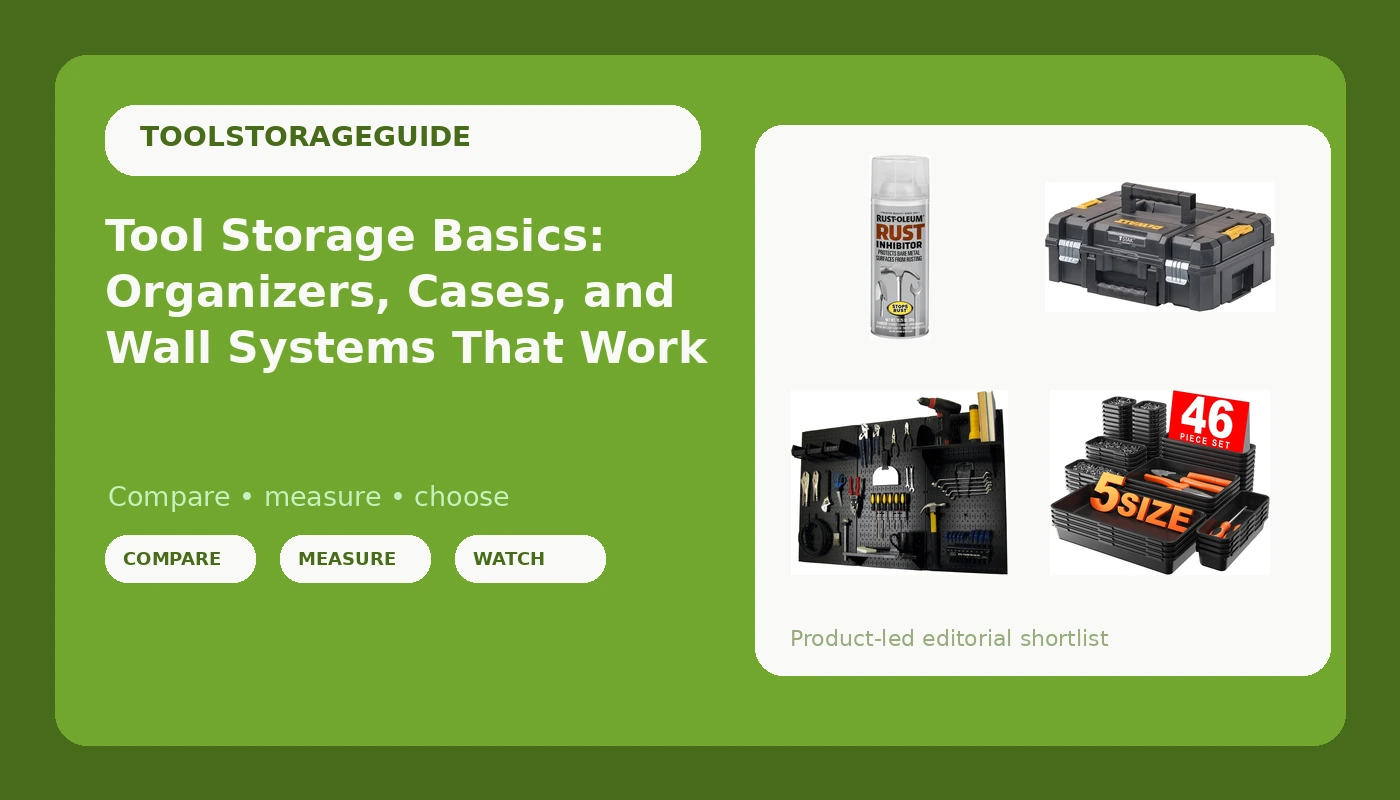
Most garages do not have a tool problem. They have a placement problem. The tools are fine; they are just living in three wrong places at once, a heap in an open box, a pile on the bench, and wherever the last job left them. A tool storage organizer system fixes that by giving every tool a fixed address and by protecting the steel while it sits there. The four items below cover the four jobs a small shop actually needs done: carry tools to the job, hang the daily users within reach, divide a drawer so sockets and wrenches stop mixing, and put a moisture barrier on bare metal in a garage that swings from humid to freezing and back.
Related: Garage Tool Wall Layouts That Survive Daily Use →
Quick answer
Start with where the tool is used, then buy storage for that spot. A stackable hard case covers portable tools and trips to a job site. A metal pegboard kit covers the wall and the tools you grab every day. A divider set covers the drawer so small parts stop migrating. A clear corrosion inhibitor covers the bare steel that lives in an unheated garage. None of these four replaces a full chest with ball bearing slides; they are the layer that keeps a chest, a bench, and a bag from collapsing into one pile. Match the item to the job, and the money goes further than any single large purchase.
4 useful options
| Model | Best fit | What stands out |
|---|---|---|
| DEWALT Tool Box TSTAK II, 13 In. Flat Top Tool Storage Case | Portable tools and job-site trips | Stackable flat top hard case rated to hold up to 66 lbs |
| Wall Control Pegboard Organizer 4 ft. Metal Pegboard Standard Tool Storage Kit | Wall storage for daily users | 4 ft steel toolboard kit with black board and black accessories |
| A-LuGei 5-Size Tool Box Organizer Tray Divider Set Drawer Organizer | Drawer and box interiors | Five tray sizes that divide one space into many |
| Rust-Oleum Stops Rust Corrosion Inhibitor Spray, Clear | Bare metal that sits in a garage | Clear anti-rust coating that forms a moisture barrier, indoor or outdoor |
Portable storage: DEWALT Tool Box TSTAK II, 13 In. Flat Top Tool Storage Case
A portable case earns its space or it becomes another container in the pile. The argument for a flat top design is that it uses vertical room instead of stealing it: stack two or three cases and the footprint on the shelf stays the same while the tool count goes up. The argument against buying a whole stack at once is that most home shops only need one case for the tools that actually travel, which is usually a drill, a driver, a meter, a set of pliers, and the fasteners for the job at hand.
Read the capacity number the way a shop reads it. A rating of up to 66 lbs assumes a load spread across the bottom of the case. A single heavy item, a full socket rail or a hammer, concentrates that load in one spot, so it makes sense to keep dense items low and flat and put lighter tools on top of them. That habit also keeps the case from shifting when it rides in a truck bed.
Wall storage: Wall Control Pegboard Organizer 4 ft. Metal Pegboard Standard Tool Storage Kit
A wall is the cheapest storage in the building and the most commonly wasted. Pegboard works because it turns a flat surface into a grid of attachment points, and the standard hole pattern means hooks and bins are interchangeable and easy to replace later. The trade-off is that a wall only helps if the tools on it are the ones you reach for daily. Fill a pegboard with once-a-year tools and you have built a display, not a work surface.
Steel panels change the failure mode. Thin composite board is fine until a hook is loaded hard and repeatedly; then the hole ovalizes and the hook drops out. Metal resists that, which is why a steel toolboard is a reasonable choice for the wall above a bench where pliers, hammers, and frequently used wrenches hang within arm's reach. Plan the layout by reach: most used at chest and shoulder height, heavier items low, and anything you have to stretch for is a tool that should live in a drawer instead.
Drawer control: A-LuGei 5-Size Tool Box Organizer Tray Divider Set Drawer Organizer
The single most useful thing you can do to a toolbox is reduce the number of decisions it takes to put a tool back. A divider set does that by cutting one large cavity into several small ones, so a wrench has one place to land instead of a dozen. Multiple sizes matter here, because a drawer that is mostly sockets needs a different internal geometry than a drawer of screwdrivers and picks.
Measure before you commit. Trays that do not fill a drawer leave gaps where small parts migrate, and trays that overfill it make the drawer hard to close and harder to search. A workable approach is to lay the tools out on the bench first, group them by how often they are used together, and only then pick the tray sizes that match those groups. If a group does not fit a tray, the group is probably too big and belongs in a second drawer.
Rust protection: Rust-Oleum Stops Rust Corrosion Inhibitor Spray, Clear
Storage is only half of protection. An unheated garage cycles through temperature swings that pull condensation onto cold steel, and a drawer is not a sealed environment, so bare metal table tops, hand planes, chisels, and machine surfaces can flash rust even when they are put away. A clear inhibitor adds a barrier between the steel and the moisture in the air without hiding the surface underneath.
Order of operations matters. Clean and dry the metal first, because a coating sprayed over grit or existing rust holds the problem in place rather than stopping it. Work in a ventilated space, apply an even coat, and let it cure before the tool goes back into the drawer. On tools with cutting edges, keep the coating away from the edge itself and treat only the body and any exposed steel, since a coating is not a substitute for a wipe down and a light oil on the working surfaces.
What "organized" actually means in a working garage
Organization gets sold as an aesthetic, but in a shop it is a timing problem. A tool that goes back where it belongs in two seconds stays in the rotation. A tool that requires opening the right drawer, moving something out of the way, and finding a gap does not. Every storage decision below is really a decision about how long it takes to put a tool away, and the winning setup is the one where putting the tool away is faster than leaving it on the bench.
That is why the four categories in this article are not competing with each other. A wall panel handles the tools used every single day and needs zero opening and closing. A drawer with dividers handles the tools used weekly. A portable case handles the tools that leave the building. Corrosion protection handles everything that stays put for months. Buy in that order and you are solving the actual bottleneck rather than collecting containers.
Steel, moisture, and the tools you already own
The steel a tool sits in or on matters more than the color and the badge. Sheet metal thickness, sometimes described as gauge, shows up in how much a panel or a lid flexes under load, and flex is what eventually cracks paint, loosens rivets, and lets moisture in at seams. You can judge a lot of this without instruments: open a lid, press the center, and watch how far it moves before it comes back. A panel that feels like a drum is not going to hold a loaded hook for a decade.
Weight ratings need the same skepticism. A capacity figure is normally calculated with the load spread evenly across the structure, which is not how a drawer or a case gets loaded in real life. A drawer of sockets, a case with a hammer in one corner, and a pegboard hook holding a heavy wrench are all point loads, and point loads are what bend slides, bow panels, and tear hooks out of board. Spread dense items, keep the heaviest things low, and treat every capacity number as a ceiling rather than a target.
A sensible order of operations for a home garage:
- Sort the tools into daily, weekly, and seasonal groups before buying anything.
- Put the daily group on the wall, within arm's reach of the bench.
- Put the weekly group in a drawer and divide that drawer so each tool has one landing spot.
- Put the traveling group in a stackable case sized to what actually leaves the garage.
- Treat bare steel in the seasonal group with a corrosion inhibitor before it goes into storage.
- Revisit the layout after a month, because the first version is almost never the final one.
Practical guidance for a small shop
- Measure the drawer, the shelf, and the wall before ordering, and write the numbers down. Storage that almost fits is storage you will fight.
- Keep the heaviest tools low and centered. High and off to one side is how hooks pull out and drawers sag.
- Group tools by job, not by category. The tools used together should live together, even if the catalog disagrees.
- Leave roughly a fifth of every drawer empty. Storage with no slack has no room for the tool you buy next month.
- Clean and dry metal before any coating goes on, and store the spray can upright so it is ready the next time rust shows up.
- Check that a case or panel stacks with what you already own before adding another system to the shelf.
Which option should you choose?
Choose the DEWALT Tool Box TSTAK II, 13 In. Flat Top Tool Storage Case when the tools that give you trouble are the ones that leave the garage, and you want a stackable hard case with a flat lid and a stated capacity of up to 66 lbs. Choose the Wall Control Pegboard Organizer 4 ft. Metal Pegboard Standard Tool Storage Kit when the bottleneck is the bench itself and the daily tools need to be off it, within reach, on a steel panel with standard spacing. Choose the A-LuGei 5-Size Tool Box Organizer Tray Divider Set Drawer Organizer when your drawers and boxes are technically big enough but nothing stays where you put it. Add the Rust-Oleum Stops Rust Corrosion Inhibitor Spray, Clear when the tools are already stored but the steel is showing rust or you want a clear moisture barrier on bare metal in an unheated space.
A caveat worth stating plainly: none of these products is a substitute for a chest or cabinet with quality slides, and none of them will fix a shop that has more tools than homes. If a drawer is overloaded, dividers make the overload tidier but no lighter. The four items here work as the layer around a main box, not as a replacement for one.
The bottom line
A tool storage organizer system is less about the containers and more about the number of steps between using a tool and putting it back. A stackable case for the tools that travel, a steel pegboard panel for the tools you grab daily, a divider set for the drawer that keeps mixing itself up, and a clear corrosion inhibitor for the bare steel that sits through a humid Ohio winter cover the four jobs a home garage actually has. Buy them in the order that matches your worst bottleneck, keep the heavy loads low and spread out, and leave room for the next tool.
Prices and availability may change. Product images, names, and retailer links must be matched by verified ASIN. Do not state a current price, rating, stock status, or measured result without current evidence.