Related: How to Organize a Rolling Tool Chest So You Actually Put Tools Back
I've been a diesel mechanic for 16 years, and my home shop started as one toolbox. It has metastasized into three. Somewhere along the way I became the guy friends call when they are staring at modular tool storage on a screen and cannot tell a real drawer from a plastic tray.
Here is what I tell every one of them. The box does not organize your tools. You do. The box only makes putting a tool back easier than leaving it out. That is the entire job, and it is harder than it sounds. If a drawer fights you at 9 p.m. after a 12-hour shift, your 10mm ends up on the bench, then on the floor, then in a coffee can of shame. I watched an apprentice lose three 10mm sockets in one week, and the box was not the problem. The layout was.
So I judge tool storage the way a shop uses it. Open the drawer. Feel the slide. Load it with sockets, because a drawer full of sockets is never an evenly spread load no matter what the weight rating claims. Roll it across a cracked slab. Then answer one question: would I put my own tools in it?
That question is the whole review. Everything below is the reasoning behind the answer.
Best Overall for a Home Shop: Husky 52 in. 15-Drawer Combo
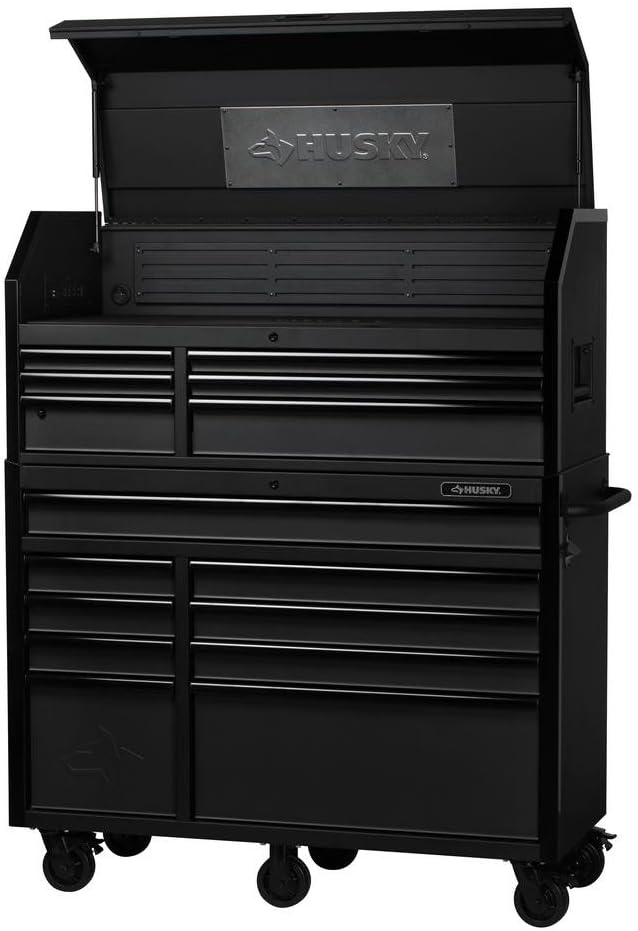
The Husky 52 in. 15-Drawer Industrial Tool Chest and Cabinet Combo is the best value for home mechanics, and I say that without hedging. The slides are smooth, the price is right for what you get, and 15 drawers is enough separation that sockets stop living in the same pile as pliers and tape measures.
Fifteen drawers sounds like overkill until you have lived with four. Drawer count is not about capacity. It is about decision speed. When every category has its own home, putting tools away becomes a two-second motion instead of a sorting project. That is the difference between a clean box and a bench that looks like a yard sale.
The combo format matters too. A chest on top of a cabinet gives you shallow drawers up high for sockets, wrenches, and drivers, and deeper space down low for the bulky stuff that eats drawers alive. The casters are the part people ignore until they move shops, and then they thank past you for buying a box that rolls instead of a box that has to be disassembled and carried. Locking casters are non-negotiable on a loaded box, and this one has them.
Where it earns its keep is stability. Open the drawer. Feel the slide. That is the whole review. Ball bearing slides on a box this size mean you can pull a loaded drawer all the way out without the whole chest trying to tip forward or the drawer sagging at the front edge. Friction slides on a box at this level would be a crime, and Husky did not commit it.
If you work out of one spot every day, this is the box. If you work out of a truck, skip to the next section.
Best Modular System: Milwaukee Packout 3-Drawer Tool Box
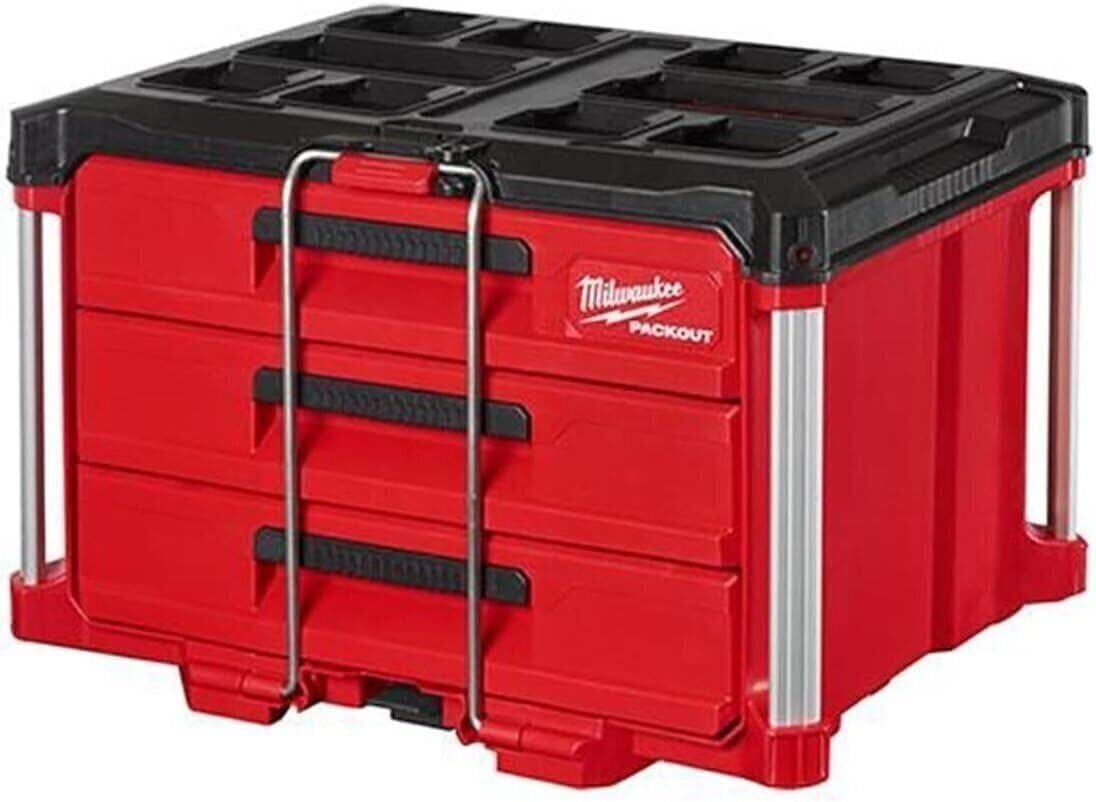
Packout is the best modular system on the market, and the 3-Drawer Tool Box is the piece that makes the whole thing work. The drawers lock tight, the cases stack like LEGO for adults, and the system does something a traditional chest cannot: it comes with you.
That last point is the entire argument. A chest is a fixed asset. It organizes tools beautifully as long as the tools stay in the building. The moment you have to carry a set to a job, a friend's garage, or the driveway, a chest becomes a liability and a modular stack becomes the answer.
The 3-drawer unit is the sweet spot in the line because drawers beat deep bins for anything you actually reach for. A deep tote turns into a landfill. You throw things in, you dig for them later, and the thing at the bottom has not seen daylight since you bought it. Drawers force a little discipline on you, and the locking mechanism means they stay shut in transit instead of dumping your sockets across a truck bed.
The tradeoff is capacity per dollar. You are paying for modularity and durability, not for cubic feet. If your tools never leave the shop, a Husky combo gives you more storage for less money. If your tools travel, Packout is worth every cent, because a system that comes with you is the only system that stays organized.
How I judge tool storage
Four checks, every time, in this order.
One: do the slides survive loaded slams? Open a drawer, put weight in it, and let it close the way it closes when you are tired and not being careful. If it rattles, binds, or needs a second shove, it fails. That is the test that matters most, because the closing motion is what you do fifty times a day.
Two: does the gauge steel resist flex? Gauge steel is how thick the sheet metal is, and thicker means heavier and sturdier. You can feel it in the lid flex. Press down on the top of a box. If it gives, the drawers below it are going to sag when you load them, and sagging drawers are the beginning of the end.
Three: do the casters roll and lock properly? A caster that locks on one wheel only is worse than no lock at all, because it gives you false confidence on a sloped driveway. Roll the box, lock it, and push it. If it walks, it fails.
Four: would I put my own tools in it? This is the gut check that overrides the other three. Some boxes pass every measurement and still feel wrong when you open them. Some cheap boxes feel right immediately. The gut check catches what the checklist misses.
I do not care about keyed locks. Nobody uses them. I care about whether the drawer I open a hundred times a day still feels the same in year two as it did in week one.
What the specs do not tell you
Weight ratings are measured with the load spread evenly across the drawer. A drawer full of sockets is not even. It is a brick sitting at the front of the drawer, and that is the load that finds weak slides. So I discount the rating and judge the slide itself.
The other thing the spec sheet hides is where the money went. On a cheap box, it went into the paint and the label. On a good box, it went into the slides, the steel, and the casters. You cannot see any of those three in a product photo, which is exactly why people buy the wrong box online.
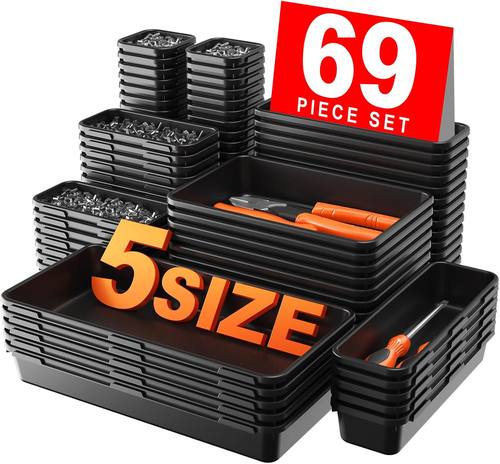
Organizer inserts are the cheapest fix in the shop. A tray insert keeps sockets and bits from rolling into a pile at the back of the drawer, and it makes putting tools away faster than dropping them loose. If you already own a chest and it has gone feral, buy the insert before you buy another box. Half the time, that is the actual problem.
One more: skip anything with friction slides in the description. In year two, you will be pulling drawers with both hands, and then you will stop putting tools away at all.
Tool storage comparison table
This is how the four options stack up against the checks above. Prices move constantly, so check the current listing before you commit.
| Storage system | Best for | Drawers and slides | Price |
|---|---|---|---|
 Visit on Amazon → Visit on Amazon →Husky 52 in. 15-Drawer Combo |
Home shop anchor | 15 drawers, ball bearing | Check current Amazon price |
 Visit on Amazon → Visit on Amazon →Milwaukee Packout 3-Drawer |
Job site and mobile work | 3 locking drawers, stackable | $184.90 |
 Visit on Amazon → Visit on Amazon →Keter Stack N Rolling 3 Piece |
Light garage and yard storage | Trays, resin body | $118.99 |
 Visit on Amazon → Visit on Amazon →A-LuGei Tool Box Organizer |
Fixing a drawer you already own | Insert, no slides | $27.99 |
Keter Stack N Rolling Tool Box Modular Storage System 3 Piece
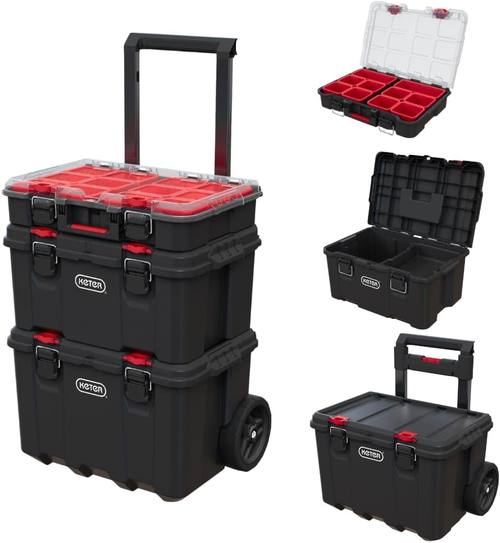
Keter's resin cabinets are fine for light garage stuff, but they are not tool storage, no matter what the box says. The Stack N Rolling system is a three piece modular setup with a rolling base, and it does the job it was built for: moving hose fittings, extension cords, sprayers, and yard tools from the shed to the driveway without a trip back.
Where people go wrong is buying it for sockets. Resin does not have the rigidity of steel, and a loaded socket set in a resin tray is going to shift and rattle in a way that steel never will. Treat it as mobile garage storage for the light stuff and it earns its spot. Treat it as a tool chest and you will be disappointed by spring.
The rolling base is the best part. If your garage storage problem is really a moving-things-around problem, this solves it.
A-LuGei Tool Box Organizer
The A-LuGei Tool Box Organizer is not a box. It is the thing you put inside the box, and it is the upgrade that changes how a drawer feels. If your sockets live in a pile and you spend thirty seconds hunting every time, this fixes that for less than the cost of a decent ratchet.
This is the organizer move, and it is the one people skip. They buy a bigger chest when what they actually needed was homes for the tools they already own. Every tool has a home. If it does not, you do not need more tools, you need more homes. A tray insert is the cheapest way to buy homes.
It works in a Husky drawer, in a Packout drawer, in a bench drawer, in a service cart. That is the point. It is not tied to one system, and it makes whatever box you already own function better.
Should you buy the Husky 52 in. 15-Drawer Combo?
Yes, if your tools live in one place. It is the best value for a home mechanic, the slides are smooth, and 15 drawers give you the separation that keeps a shop from turning into a pile. The combo format means shallow drawers up top and real volume down low, and the casters mean you can move the whole thing without unloading it.
Should you buy the Milwaukee Packout 3-Drawer Tool Box?
Yes, if your tools travel. It is the best modular system going, the drawers lock tight, and it stacks like LEGO for adults. You give up capacity per dollar compared to a stationary chest, and you get it back every time you carry a full set to a job without repacking anything.
Should you buy the Keter Stack N Rolling system?
Buy it for light garage and yard storage, not for your socket set. The rolling base and the stacking trays are genuinely useful for the odds and ends that clutter a garage, and the resin body keeps the weight down. Just do not ask it to be a tool chest.
Should you buy the A-LuGei Tool Box Organizer?
Yes, and buy it before you buy another box. It is the least expensive way to make the storage you already own work the way it should. If your drawers are a pile, this is the fix, and it fits whatever system you run.
The best tool storage is the kind that makes putting tools away easier than leaving them out. Buy the box that fits how you actually work, then spend the rest on the homes inside it. A clean toolbox is a fast toolbox, and that has been true since the first guy slammed his first drawer.