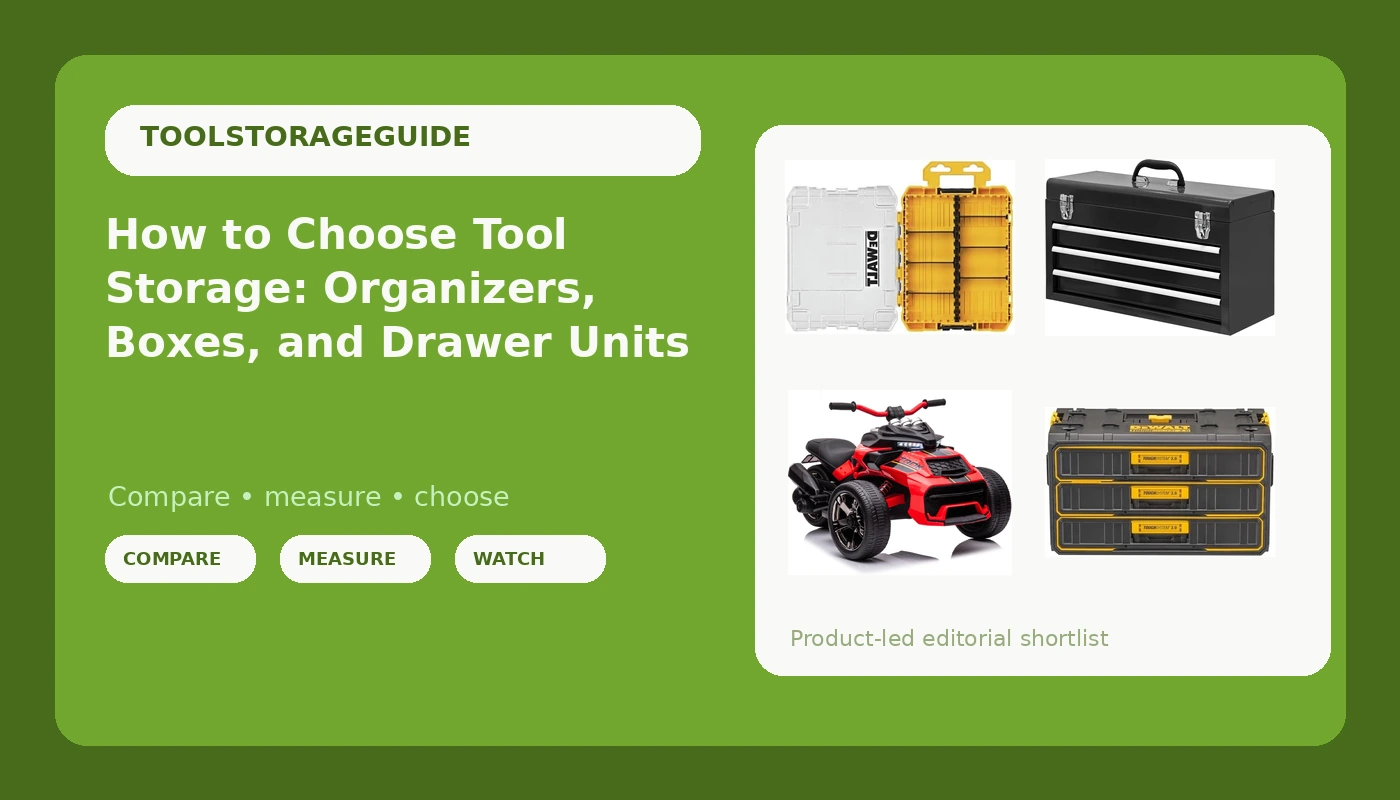
Tool storage is the part of the shop you notice only when it fails. A tool storage organizer that keeps sockets, bits, and fasteners where you can actually find them saves you minutes every single day, while a box that swallows everything into one pile charges those minutes back with interest. The complication is that "tool storage" covers at least three separate jobs, and the four listings below sit in different corners of that map: a modular drawer unit, a small parts case, a portable metal box with drawers, and one item that is not tool storage at all. Matching the product to the job is the entire decision.
Related: Tool Chest Drawer Slides Explained →
Quick answer
Start with what has to move. If the tools live in one spot, a drawer unit or chest with real slides does the work, and you should judge it by how the drawer feels when it is loaded. If the tools travel to the job, a portable case wins, because a heavy stationary box that never leaves the bench is a bench, not a toolbox. If the problem is a drawer full of loose screws, bits, and small parts, a compartment organizer fixes it for far less than new furniture. And if a listing turns out to be a kids' ride-on toy, it is not a storage answer at all, no matter how it got into the search results.
Four useful options
| Model | Best fit | What stands out |
|---|---|---|
| DEWALT TOUGHSYSTEM 2.0 Tool Organizer and Storage 3 Drawer Unit (DWST08330) | Fixed shop or truck storage that grows | Three drawers inside a stackable modular platform |
| DEWALT Tool Box, Medium 8-Compartments Small Parts Organizer, Portable Tough Case (DWAN2190) | Loose small parts and fasteners | Eight compartments with customizable dividers |
| BIG RED Metal Tool Box, 20.5-inch, Portable Metal Tool Box with 3 Drawers | Grab-and-go metal storage | Metal construction, 20.5-inch footprint, three drawers |
| 24V Ride On Toys for Kids 4-8 Kids' Electric Motorcycle 3 Wheeler ATV | Not shop storage | A ride-on toy, listed here only to flag it |
The modular drawer unit: DEWALT TOUGHSYSTEM 2.0 Tool Organizer and Storage 3 Drawer Unit (DWST08330)
This is the pick for someone who has already decided the tools are staying put, or who wants a stack that can move as a single unit when the job changes. The trade-off is depth. Drawer units in this format tend to favor shallow drawers that keep small and medium tools visible, which is great for wrenches, pliers, and meters, and less great for the bulky stuff you would otherwise drop into a deep chest. It also assumes you buy into the platform; a single three-drawer unit is useful, but the value shows up when it becomes one layer of a stack.
The other thing to weigh is that modular drawers are usually open-topped or stack-topped rather than sealed. That is fine in a garage, and less fine on a trailer in the rain. Decide where this lives before you buy it.
The small parts organizer: DEWALT Tool Box, Medium 8-Compartments Small Parts Organizer, Portable Tough Case (DWAN2190)
Most people who think they need a bigger toolbox actually need this instead. The failure mode is a top drawer that becomes a landfill of screws, washers, and mystery fasteners, and no amount of extra square footage fixes that. Compartment organizers do, because they force a decision about every item: it goes in a compartment or it leaves the shop.
The trade-off is capacity and weight. Eight compartments is a lot of sorting for a small volume, and once you fill it with dense hardware, the case itself becomes something you carry with two hands. Treat it as a parts case that lives inside a drawer or on a shelf, not as your primary tool carrier. Divider systems also only work if you actually re-dividing them when your hardware mix changes, which is a two-minute job that most people skip until the day a compartment overflows into its neighbor.
The portable metal box: BIG RED Metal Tool Box, 20.5-inch, Portable Metal Tool Box with 3 Drawers
This is the shape most people picture when they hear "toolbox," and it still earns its place. A 20.5-inch metal box with drawers is the right answer for someone who carries a defined set of hand tools to a specific task and wants them separated on arrival instead of dumped in one cavity.
Be honest about the limits. Small drawer boxes are for hand tools, meters, and consumables, not for a full socket set or anything that needs deep storage. Metal construction is a durability signal, but it is not a weight rating, and no listing tells you how the drawers will feel in year three. Before committing, check whether the drawers are the kind that glide or the kind you drag; that single detail determines whether the box stays pleasant or becomes a daily annoyance. If you cannot see that in the listing, it is a reason to buy from somewhere with an easy return.
The outlier: 24V Ride On Toys for Kids 4-8 Kids' Electric Motorcycle 3 Wheeler ATV
This one is here because it turned up alongside the storage listings, and leaving it out silently would be worse than naming it. It is a kids' ride-on toy. It has no drawers, no compartments, no gauge steel, and no place in a garage tool setup. If you clicked into this article looking for a place to put your wrenches, this is not it. If you are shopping for a child's ride-on, evaluate it on toy criteria, not on storage criteria, and check the listing for the age range and safety information the seller provides.
What actually separates good storage from bad
Three things decide whether a storage product earns its footprint, and only one of them is visible in a photo.
The first is the slide mechanism on anything with drawers. Slides come in roughly two families: those with rolling elements and those that rely on friction between surfaces. Rolling slides carry load more smoothly and hold up longer under repeated cycling; friction slides are cheaper and get progressively harder to pull as they wear. On a light drawer that holds a few hand tools, either can be acceptable. On a loaded drawer, the difference is the entire ownership experience.
The second is how the drawer box is built. Steel thickness matters, but it is not the only variable. Drawer side height, how the drawer bottom is attached, and how the slides are mounted to the cabinet all affect whether a loaded drawer sags at full extension. A thick cabinet with thin drawers is still a box that will droop.
The third is whether the layout matches your tools. Deep drawers reward bulky items and punish small ones, because small items disappear into the pile. Shallow drawers do the reverse. Most shops end up wanting both, which is why mixed configurations beat any single-drawer-depth setup.
Modular systems versus traditional boxes
The modular approach treats storage as a stack of compatible units: cases, drawers, and tote boxes that latch to one another so the whole assembly moves as one piece. The advantage is flexibility. You add a layer when you outgrow one, and you carry the stack with a cart instead of making six trips. The cost is commitment. Modular units are most useful inside their own ecosystem, and mixing brands usually means losing the latching.
Traditional boxes and chests trade flexibility for simplicity. One box, one footprint, no compatibility question. A portable metal box with drawers is the classic version of this, and it remains the better answer when your tools move by hand rather than by cart.
There is no universal winner here. There is only the question of whether your storage moves. If it moves with a cart or a truck bed, modular wins. If it moves in your hand, a portable box wins. If it does not move at all, buy the deepest, sturdiest drawer configuration you can afford.
- List what has to be stored by category: hand tools, small parts, power tools, consumables.
- Decide whether each category stays in one place or travels with you.
- For anything that travels, pick a portable format first and check the size against what you carry.
- For anything that stays, prioritize drawer depth and slide quality over total drawer count.
- Reserve one container for small parts and keep it separate from the tool drawers entirely.
Setting up storage so tools actually go back
- Sort by frequency of use, not by tool type. The tools you reach for hourly belong at hand height, not alphabetized on a shelf.
- Give every small part a compartment. A parts case with customizable dividers is worth more than extra drawer space.
- Keep one clearly labeled container for the fasteners you cannot identify. It stops the "I will sort this later" pile from forming.
- Do not buy a larger box to solve a clutter problem. Measure the tools you have and add capacity for roughly a year of growth, not for the tools you imagine buying.
- Check the return policy before you commit to anything with drawers. Slide feel is the one thing a listing cannot tell you.
Which option should you choose?
Choose the DEWALT TOUGHSYSTEM 2.0 Tool Organizer and Storage 3 Drawer Unit (DWST08330) when your tools live in one place and you want a stackable drawer system that can grow or move as a single unit. Choose the DEWALT Tool Box, Medium 8-Compartments Small Parts Organizer, Portable Tough Case (DWAN2190) when your real problem is loose hardware scattered across a drawer and you need compartments with dividers you can rearrange. Choose the BIG RED Metal Tool Box, 20.5-inch, Portable Metal Tool Box with 3 Drawers when you carry a defined set of hand tools by hand and want them separated on arrival. And choose the 24V Ride On Toys for Kids 4-8 Kids' Electric Motorcycle 3 Wheeler ATV only if you are shopping for a child's ride-on toy, because it is not a storage product and will not organize anything.
One caveat applies to all of this. The distinctions above rest on product type, stated dimensions, and platform compatibility as described in the listings. They do not rest on load testing, long-term durability results, or measured slide performance, because none of that is available from a listing page. If slide quality is the deciding factor for you, buy where returns are simple.
The bottom line
Tool storage decisions go wrong when the product type does not match the job. A drawer unit for tools that never leave the shop, a compartment organizer for the drawer full of loose fasteners, and a portable metal box for tools that travel cover the three real jobs, and they cost far less than buying one oversized chest and hoping it solves all of them. Match the format to how the tools move, check the drawer mechanism before you commit, and skip the listings that are not storage products at all.