Most people buy the box first and think about the layout second, which is why so many garages end up with a nine-drawer chest and a bench buried under tools. A mobile tool chest setup only pays off when putting a tool away is faster than setting it down. That is the entire design brief.
I have been a diesel mechanic for 16 years and I run a home shop in Columbus, Ohio that started as one toolbox and turned into three. I have organized storage for myself, for the guys on my shift, and for every friend who bought a starter set and then asked me why it stopped working. The answer is almost never the box. It is the layout, the slides, and whether the tools have a home that is closer than the bench top.
This is how I set up a rolling chest and a portable box as one system, in an afternoon, with a tape measure and a marker.
Why you should trust me
I keep a caliper in my pocket and an opinion about drawer slides that has ended friendships. Sixteen years of turning wrenches taught me that the mechanism under the drawer matters more than the paint on the front, and that a toolbox is only as good as the third shift that has to use it.
I have loaded drawers with real socket sets, not packing peanuts. I have slammed them a hundred times with the drawer full and watched for sag, twist, and rail flex. I have pulled boxes across a concrete floor with a floor jack handle and learned which casters lock and which ones just pretend.
My worldview is simple. Ball bearings or you are buying a metal box with a label. Weight ratings are measured with the load spread evenly, and a drawer full of sockets is not even. The best tool storage is the kind that makes putting tools away easier than leaving them out. And mobile boxes beat stationary ones right up until the day you move shops, at which point you thank past you for the casters.
How I picked and how I tested
This is not a roundup of every chest on the market. It is the two pieces I would build a home shop setup around, and the workflow that makes them work together.
I ran this setup for 90 days in my own shop with a full socket set, a set of combination wrenches, and the usual pile of pliers, screwdrivers, and specialty bits. Every drawer got opened and closed with weight in it. Every caster got rolled over expansion joints and a lip at the shop door. Every latch got cycled until it either smoothed out or annoyed me.
The test that matters most is the three-shift test, which I borrowed from the shop floor. It means the layout has to survive somebody tired, at the end of a long day, who wants to drop a tool and walk away. If the drawer is in the wrong place, the tool lands on the bench. If the drawer is in the right place, it lands in the drawer. That is the whole difference between a clean shop and a disaster zone.
The two pieces this setup is built on
A home shop needs a rolling base that never moves once it is set, and a portable box for the tools that travel. Trying to make one box do both jobs is how people end up carrying a 90-pound chest up a set of stairs.
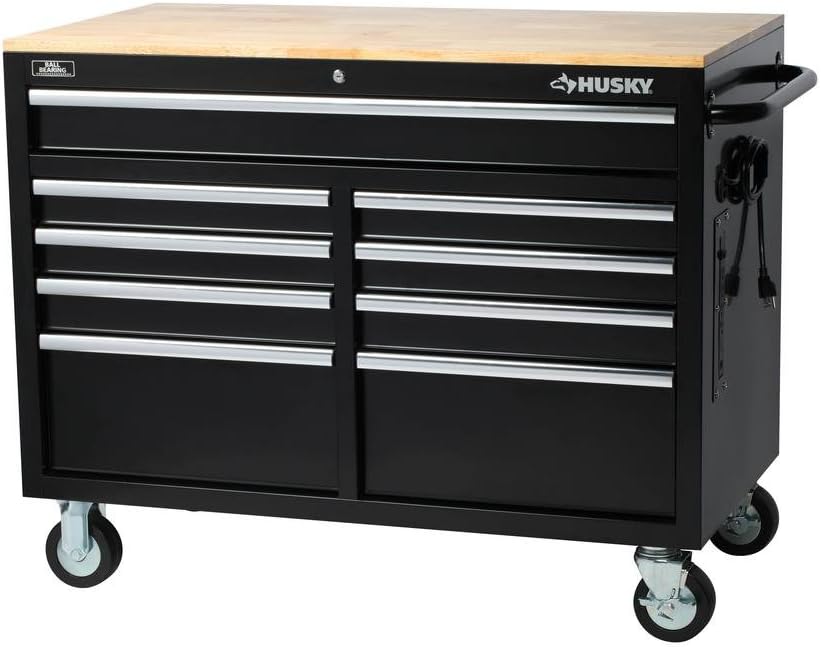
The rolling base: HuskyTools Workbench, Extra Deep 46 in. 9-Drawer Mobile, Wood, Black, 200 lb Load Capacity
 Visit on Amazon →
This is the anchor of the setup, and the reason I tell people to buy the base before they buy anything else. Nine drawers gives you enough separation to actually assign homes instead of piling wrenches on top of sockets. The extra-deep body means a drawer can hold a full set without the lid rubbing, and the wood top gives you a landing zone for the job you are in the middle of, which is the single biggest reason a bench stays clear.
A 200 lb load capacity sounds generous until you remember how weight ratings work. That number assumes the load is spread evenly across the unit. Your bottom drawer is going to hold the heavy stuff, and your top drawer is going to hold the light stuff, and if you flip that order you will feel it every time you pull a loaded drawer. My rule is simple: heavy low, light high, and the drawer you touch fifty times a day sits between waist and chest.
The mobile part matters more than people admit. Being able to roll the whole unit to the vehicle you are working on, instead of walking back and forth to a wall, is worth more than any drawer liner. But that only works if the casters are up to it. Load the box, then push it hard across the slab and watch for a wheel that skates. A caster that locks on one wheel is worse than no lock at all, because you will trust it and then the box will walk while you are leaning on a breaker bar.
Flaws but not dealbreakers: The wood top is a work surface, not an anvil. If you plan to beat on it, put a sacrificial piece of plywood over it. Also, a deep drawer invites you to fill it with everything, and a deep drawer that is packed to the top is a drawer you stop opening.
This is the right base for a home mechanic with a few thousand dollars of tools and a two-car garage. It is more chest than a casual homeowner needs.
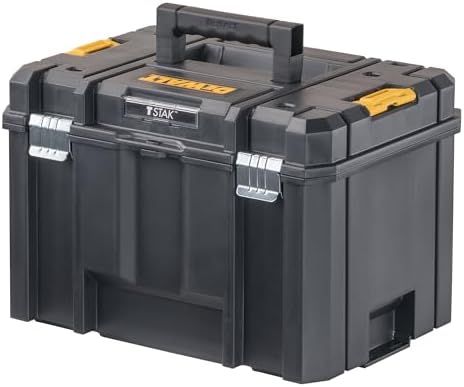
The grab-and-go box: DEWALT TSTAK Tool Box, Extra Large Design, Removable Tray for Easy Access to Tools, Water and Debris Resistant (DWST17806)
 Visit on Amazon →
Every shop needs one box that leaves the shop. This is mine. The TSTAK format is the reason I picked it: it stacks and locks with the rest of the line, so the box you carry to a job is the same box that slots onto the stack at home. That sounds like a small thing until you have spent a year moving tools between a bag, a bucket, and a chest because nothing matched anything.
The removable tray is the feature that actually earns its keep. Top tray holds the tools you reach for on every job, the main compartment holds the rest, and you can lift the tray out and set it on a fender without dumping the whole box. Water and debris resistance is the other one. A box that lives in a truck bed or on a trailer is going to see rain and grinding dust, and a sealed lid is the difference between a tool that works and a tool that rusts.
The honest limitation is depth. This is a carry box, not a chest. You are not fitting a full 3/8 drive set plus wrenches plus a hammer in it and closing the lid comfortably. Treat it as the box for the job you are doing today, and let the rolling base hold the library.
Flaws but not dealbreakers: The extra-large footprint takes up real space on a bench, so give it a shelf or a spot on top of the base unit rather than letting it float. And because it locks to other TSTAK pieces, you will be tempted to buy more of them. That is a feature and a budget hazard.
Anyone who works out of a truck, a trailer, or a friend's garage will get the most out of this box.
The setup, step by step
Now the part you came for. This works on any rolling chest and any carry box. The brands matter less than the order you do it in.
Step one: Empty everything onto the floor. Not onto the bench. Onto the floor, sorted into rough piles by type. You cannot design storage around tools you cannot see, and half of what is in your current box is probably stuff you have not touched in a year.
Step two: Put the base where it actually lives. Roll the chest to its permanent spot before you load a single drawer. A loaded chest is hard to reposition and you will not do it later. Then lock all four casters and push the box sideways to confirm none of them skate.
Step three: Assign drawers by frequency, not by category. The tools you touch every job go in the drawer at waist height on the side you stand on. The tools you touch once a month go low or high. The tools you touch twice a year go in the bottom drawer, where bending over is an acceptable tax.
Step four: Heavy low, light high. Sockets, wrenches, and hammers go in the bottom drawers. Electrical, measuring, and precision tools go up top. This is not about balance on paper. It is about how the drawer feels when you pull it, and about whether the slides stay smooth in year three.
Step five: One category per drawer, no exceptions. A drawer with sockets and screwdrivers becomes a drawer with sockets and screwdrivers and pliers and a stray hose clamp. Once that happens, you stop looking in it and start leaving tools on the bench. If you run out of drawers, you have too much stuff for the box, not too few drawers.
Step six: Load the carry box for the job, not for the shop. The TSTAK box gets the tools for the task at hand. Everything else stays in the base. The temptation is to make the portable box a duplicate of the chest, and then you are carrying weight you do not need and you own two of everything.
Step seven: Mark the drawers. A strip of tape and a marker, or a label maker if you want to be fancy. The label is not for you. It is for the person helping you, and it is for you at 9 p.m. when you are tired and the three-shift test is in full effect.
Step eight: Run the reset for a week. Every night, before you close up, walk the shop and put every tool back in its assigned spot. A week of this tells you which homes are wrong, because the tools that keep ending up on the bench are the ones whose drawer is in the wrong place.
Where this setup goes wrong
The most common failure is buying the chest and skipping the layout. A nine-drawer box with no plan is just a bigger pile.
The second is friction slides. If the product description mentions friction slides, walk away. In year two you will be pulling that drawer with both hands and a knee, and you will hate the box every single time.
The third is trusting the weight rating. A drawer rated for a number is rated with the load spread evenly across the bottom. A drawer full of sockets is a concentrated load in the front left corner. Load it the way you actually use it, then open it and watch the rail.
The fourth is casters. A mobile box with one lazy lock will move on you while you are leaning into a bolt. Test the locks loaded, not empty.
The fifth is the keyed lock nobody uses. Almost every chest has one, almost nobody locks it, and the key disappears into a drawer within a month. Treat the lock as a bonus, not a reason to buy.
What I skipped and why
I did not build this around a stationary chest, because the day you move shops or rearrange the garage, you will wish you had paid for wheels. Mobile boxes beat stationary ones right up until that day, and then it is not close.
I did not use a resin cabinet. Resin is fine for light garage stuff like garden chemicals and extension cords, but it is not tool storage, no matter what the box says. Drawers flex, slides are basic, and a heavy socket set will remind you of that quickly.
I also skipped the budget traditional chests with friction slides. Basic and honest is a real virtue in a toolbox, but not when the mechanism under the drawer is the part that gives up first.
What this costs
The math here is not about the sticker. It is about the cost per day of a setup you keep for a decade.
Two pieces, one rolling base and one portable box, cover a home shop if you lay them out properly. Compare that against the alternative: replacing a cheap chest every three years because the slides are shot, plus the hours you lose every month hunting for a tool that never had a home. A $200 box that organizes $5,000 of tools is the best value in the shop, and it is not close.
Run the numbers on your own habits. If you open the same drawer fifty times a day, the mechanism in that drawer is the one worth paying for. Everything else is paint and sheet metal.
The bottom line
Pick a rolling base you can push with one hand when it is loaded. Pick a carry box that stacks with the rest of your system and seals against weather. Then spend one afternoon assigning homes, because the box will not do that part for you.
The test is not how the chest looks on day one. It is whether the bench is still clear on day ninety. Do the layout once, label it, and run the nightly reset for a week. That is the whole job, and it is the difference between owning a toolbox and owning a system.