Most garages don't have a storage problem. They have a return-trip problem. Tools come out of the box just fine. They never go back in, because the box sits across the shop, the drawer is buried under three other things, and you're already reaching for the next job with a socket still in your hand.
A modular rolling tool box system fixes that, but only if you build it in the right order. Buy the box first and sort later, and you end up with an expensive plastic tower full of mystery tools. Sort first, then buy, and storage becomes the thing that makes cleanup faster than the mess.
That's the whole guide. Below is the two-piece stack I'd hand a friend starting a home shop, plus the setup order I use on my own boxes. Keep the phrase modular rolling tool box in your head while you read it: modular so it grows with you, rolling so it goes to the job, tool box so it doesn't quietly turn into a shelf.
Why you should trust me
Sixteen years as a diesel mechanic, and a home shop that started life as one toolbox and now runs three. That shop is where every storage decision I make gets graded in real time. I've also set up storage for the guys on my shift and for friends who bought a starter kit and then asked where the rest of it was supposed to live.
I use storage the way a shop uses it, not the way a showroom displays it. Drawers and lids get closed with a hip because both hands are full. Boxes get rolled over expansion joints and up the lip into the garage. I keep a caliper in my pocket, and I have opinions about drawer slides that have started actual arguments.
What I won't do is recommend a system I wouldn't put my own tools in. That's the only credential that matters here.
How I picked and how I judged the two boxes here
Every storage product in my shop has to answer the same four questions before it earns a place:
- Do the latches and slides survive loaded use, day after day, or do they loosen up by year two?
- Does the material flex when you pick the whole thing up by one handle with weight inside?
- Do the casters roll over real concrete and lock on all wheels, not just the one that happens to catch?
- Would I put my own tools in it and leave them there?
The two boxes below are what I'd start a home setup with, because they answer two different questions. One is a rolling base that carries weight. One is a portable box that carries the tools you touch every day. Neither of them is a 52-inch steel chest with ball bearing slides, and I'm not going to pretend otherwise. If that's what you want, you're reading a different article.
One more rule: I read the warranty text before I trust the phrase. A warranty is a document, not a marketing line.
The two boxes you'll need before you start
You don't need a wall of steel to fix a return-trip problem. You need a base that rolls and a box that carries. Everything else is optional, and you can add it later without rebuying either of these two.
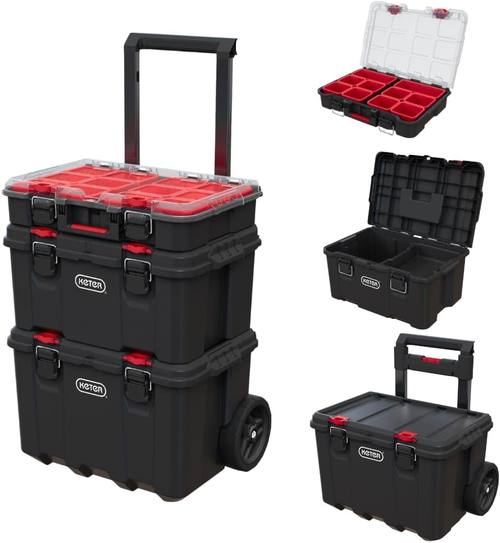
Rolling base: Keter Stack N Rolling Tool Box Modular Storage System 3 Piece
 Visit on Amazon →
This is the piece that gets your tools off the bench and out to the driveway. Three pieces that stack into one rolling unit means you can pull the whole assembly to the job and break it apart when you only need one case. Check current Amazon price.
Here's the honest version, because I'd rather you hear it from me than find out in month three: this is a resin modular system, not a steel chest. There are no drawer slides to inspect, no soft-close hardware, no 100-pound drawer rating. If that's the test you're applying, this fails it, and you should be shopping steel. What this does instead is something a stationary chest can't do. It rolls. It stacks. It breaks down into pieces you can carry one at a time, which matters more than people admit when the job is in the driveway and the chest is bolted to a wall in the garage.
There's a difference between this and the resin cabinets that show up in the garden aisle. Those are for hose reels and patio cushions. This is a modular system built to move tools around, and the three-piece setup means the whole thing works as one unit or as three separate boxes. That flexibility is the reason it's the base I'd pick for a home shop that doesn't have room for a permanent chest.
Flaws but not dealbreakers: It's resin, so don't hang a 40-pound breaker bar off a lid and expect it to feel like steel. Load it sensibly, heavy stuff low and centered, and it will do the job it was built for.
Anyone with a one-car garage, a shared driveway, or tools that need to travel between the house and the truck should start here.
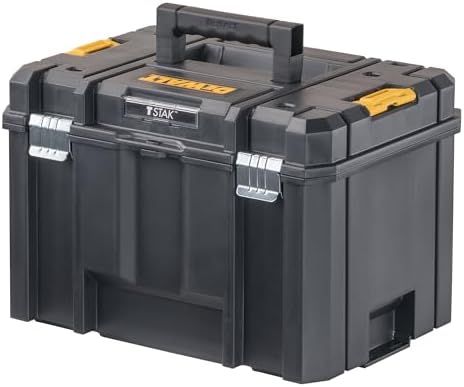
Carry layer: DEWALT TSTAK Tool Box, Extra Large Design, Removable Tray for Easy Access to Tools, Water and Debris Resistant (DWST17806)
 Visit on Amazon →
This is the box you actually carry. The extra large design gives you room for the bulky hand tools that never fit anywhere sensible, and the removable tray is the feature that earns its place. A tray you can lift out and set on the fender, the bench, or the ground next to you is the difference between a box that organizes tools and a box that swallows them. Check current Amazon price.
The water and debris resistant construction is the other reason it belongs in this setup. That covers rain on the walk from the garage to the truck and dust in a shop that makes dust all day. It does not mean you can leave it open in a downpour or park it in the bed of a truck and forget about it. Resistant is not the same word as waterproof, and anybody who tells you otherwise is selling something.
This one is part of the TSTAK line, so it clips to other TSTAK pieces if you already own some. It does not latch to the Keter unit, because those are two separate ecosystems, and I'd rather say that plainly than have you find out in the driveway. It sits on top of the stack, or it rides to the job on its own.
Flaws but not dealbreakers: Extra large means extra large. Measure the space between your bench and the wall before you decide it lives there permanently.
Anyone who wants one box that holds a full hand tool set and can be picked up with one hand should start here.
The actual setup workflow
Now the part you came for. This works whether you're starting from scratch or reorganizing a box you already own.
Step one: Empty everything onto a sheet. All of it. Every drawer, every case, every coffee can of loose hardware. You cannot organize what you can't see, and you cannot see anything inside a closed box.
Step two: Sort by job, not by size. Metric sockets together. SAE sockets together. Electrical. Air tools. Fasteners. Measuring. The instinct is to sort by size because it looks tidy in the tray, but a tidy tray isn't the goal. The goal is that your hand knows where to go without your brain getting involved.
Step three: Pick three zones. Daily, weekly, seasonal. Daily tools are the ones you touch every single job. Weekly are the specialty tools. Seasonal is everything that comes out twice a year, and most of your box is probably this. Almost every storage mistake I see is someone putting seasonal tools in the daily zone because that's where the space was.
Step four: Weight goes low and over the wheels. Heavy items go in the bottom of the rolling base, centered over the casters, not hanging off one side. A rolling box with the weight on one corner rolls like a shopping cart with a bad wheel, and you'll stop using it. Loading heavy stuff centered is the single highest-return thing you can do in this whole process.
Step five: The daily layer goes on top. This is where the DEWALT box earns its spot. Tape measure, marker, hex keys, pliers, bits, the tray with the small stuff. When a job starts, you grab the top box and walk. You don't drag the whole stack unless the whole stack is needed.
Step six: The removable tray is a work surface, not a divider. Pull it out, set it where you're working, and put the loose fasteners and small parts in it while the job is open. Tools that have a temporary home don't end up on the floor.
Step seven: Long tools lay flat. Anything that leans is a tool that falls. Pry bars, levels, long extensions, and breaker bars go flat in a dedicated slot, not propped in a corner where they can slide out the second you move the box.
Step eight: Label by zone, not by inventory. "Electrical" and "Daily" beat a label that lists every item inside. You'll change the contents. You won't change the zone.
Step nine: Do the caster test on the floor you actually roll on. Not the showroom floor. Your floor. Expansion joints, the epoxy lip at the garage door, the half inch step from the driveway, the slope toward the drain. Push a loaded box over all of it before you decide the layout is final. Locking casters need to lock on every wheel, and if only one grabs, that's a problem you'll fight every single day.
Step ten: Apply the 30-second rule. If putting a tool away takes longer than 30 seconds from the moment you finish the job, the layout is wrong, and you will leave the tool out. That's not a discipline problem. That's a design problem, and the fix is moving the tool's home closer to where you use it.
Step eleven: Reset it quarterly. Twenty minutes, once a season. Pull the daily zone, put back what migrated, and dump the tray of loose fasteners where it belongs. A box that gets a reset four times a year never needs a full rebuild.
Where people go wrong
Buying storage before sorting. The box you need is determined by the piles, not by the shelf space at the store. Sort first and you'll buy a smaller, cheaper footprint that works better.
Buying friction slides on an expensive box. If the description mentions friction slides, walk away. In year two you'll be pulling drawers with both hands and hating the box you spent good money on.
Buying the biggest box the budget allows instead of the right footprint. A box that doesn't fit the space you roll it around in is a box you stop rolling. Measure the gap between the bench and the wall before you buy.
Assuming modular systems interlock across brands. They don't, as a rule. Keter Stack N and DEWALT TSTAK are separate platforms. Stack them physically, carry them separately, and check before you assume a latch will lock.
Treating water and debris resistant as waterproof. It's a rating for rain and dust on the way to the job, not permission to store the box in the weather year round.
Locks nobody uses. A keyed lock on a tool box that lives inside a locked garage is a key you'll lose in a year. Not a dealbreaker, but not a reason to pay more either.
What this setup costs you, in plain terms
The rolling three-piece unit is the bigger single line item, and the DEWALT carry box is the smaller one. Check current Amazon price on both before you commit, because listings move and the number you see today is the number that matters.
The way I think about it: the box that organizes the tools you already own is the cheapest thing in your shop. You're not buying storage. You're buying the twenty minutes you get back every single time you finish a job and don't have to hunt for a tool the next morning. Spread that over five years and the math is not close.
The order matters more than the money. Sort, zone, load heavy low, put the daily layer on top, test the casters, and reset it four times a year.
That's the job. Your tools already have a home. You just haven't assigned it yet.