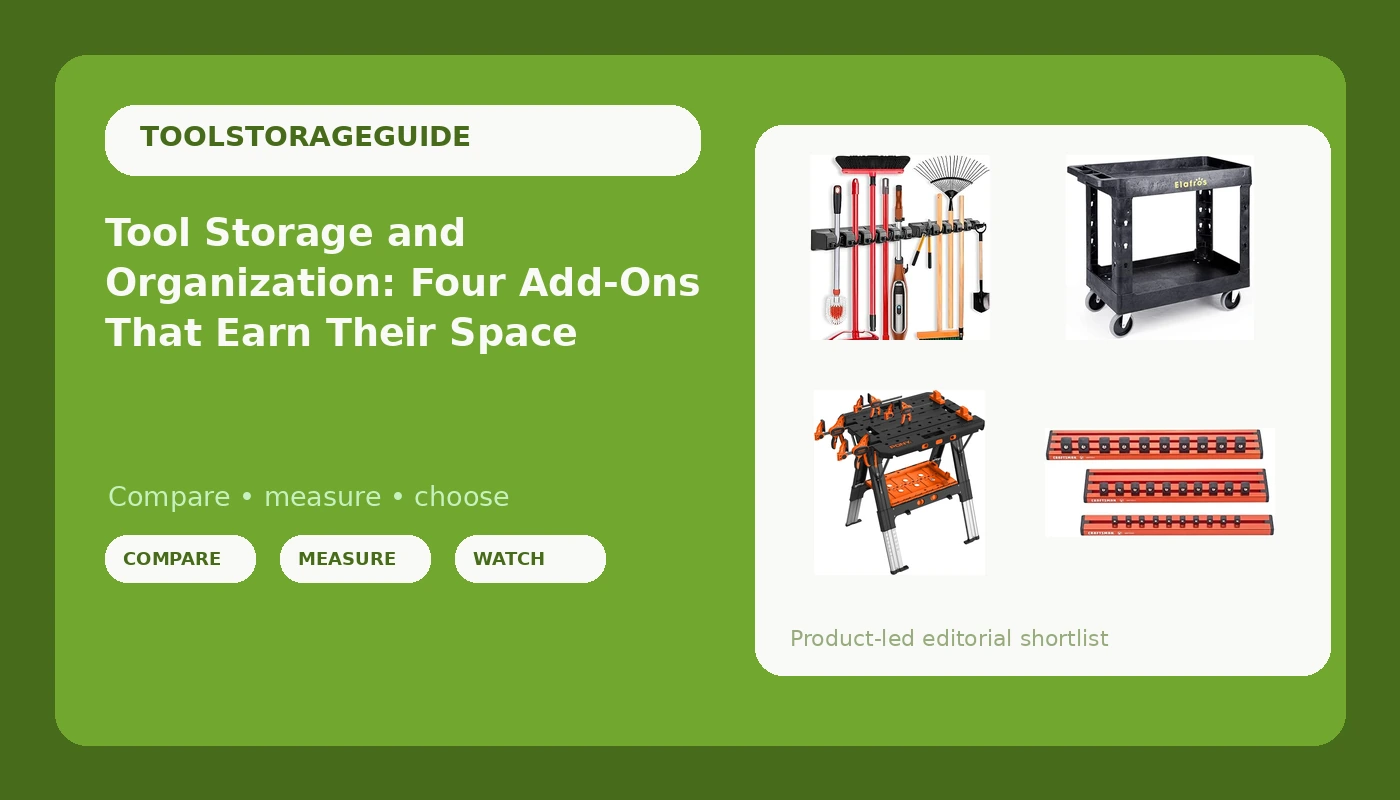
Tool storage and organization is not one purchase. It is a stack of small decisions that either make putting a tool away easier than leaving it out, or quietly guarantee you will not bother. Most home shops do not fall apart because they lack a chest. They fall apart because the broom leans in a corner, the sockets roll around a drawer in a loose pile, the "cart" is a folding chair, and there is nowhere to set a part down while both hands are busy. Add those gaps together and you get a bench that is always covered and a 10mm that is always missing.
This explainer covers the four non-chest pieces that close those gaps: a wall rack for long handles, a rolling cart for the tools that travel to the vehicle, a folding work surface for the middle of the floor, and magnetic socket organizers for the drawer that never stays sorted. None of them replaces a chest with ball bearing slides. All of them make the chest you already own easier to live with.
Related: Tool Chest Drawer Slides Explained →
Quick answer
The fastest way to improve a tool storage and organization setup is to give every item that currently has no home a home, starting with the simplest fix. For most garages that means a wall-mounted holder for brooms, mops, and long handles first, then magnetic socket organizers for the loose drawer, then a rolling cart for tools that move, and finally a folding work surface if you regularly work outside your bench footprint. Start with the wall rack because the install is simple and it removes the most visible clutter.
Four useful options
| Model | Best fit | What stands out |
|---|---|---|
| IMILLET 2 Pack Mop and Broom Holder, Wall Mount Organizer Storage Tool Rack | Long handles that have no drawer and no shelf | Two wall-mount racks in one pack for handle storage |
| ELAFROS 2-Tier Utility Rolling Cart, 34 x 17 in, 5" Swivel Wheels, 550lb | Tools that need to travel to the job | Two tiers, a 34 by 17 inch footprint, 5 inch swivel wheels, maker-rated 550 lb capacity |
| Pony Portable Folding Work Table, Workbench & Sawhorse | A work surface that stores flat when not in use | Folds away as a portable workbench and sawhorse in one unit |
| CRAFTSMAN V-SERIES Socket Organizer, Magnetic, Orange, 3 Piece (CMMT92001V) | A socket drawer that will not stay indexed | Three magnetic organizer pieces in high-visibility orange |
Long-handle storage: IMILLET 2 Pack Mop and Broom Holder, Wall Mount Organizer Storage Tool Rack
In a working shop, long handles are the one category that genuinely has no drawer. A broom, a mop, a push broom, a squeegee, a long pry bar, a framing square: all of them are too long for a chest and too awkward for a shelf, so they end up leaning in a corner where they fall over every time you reach past them. A wall rack solves that with vertical space you are already paying for and not using. The IMILLET pack gives you two racks, so you can split handles by zone, cleaning gear near the door and long tools near the bench, instead of crowding everything into one strip of wall. Mount into studs or use proper anchors, because a loaded rack pulls straight down and drywall alone will not hold it.
Mobile storage: ELAFROS 2-Tier Utility Rolling Cart, 34 x 17 in, 5" Swivel Wheels, 550lb
The rolling cart is the piece people skip and then reinvent badly with a milk crate on a dolly. What it actually buys you is travel distance. If the job is at the front of the vehicle, at the back of the garage, or out in the driveway, a cart that rolls means one trip instead of four. The ELAFROS cart lists a 34 by 17 inch footprint, two tiers, and 5 inch swivel wheels, with the maker rating it at 550 lb. Treat that number the way you should treat every capacity rating: as the manufacturer's figure for a load spread evenly across the structure, not a promise about one heavy item dropped in a corner. Two tiers matter more than the rating in daily use, because a flat top tier becomes your mobile bench and the lower tier becomes the drawer you never had.
Work surface: Pony Portable Folding Work Table, Workbench & Sawhorse
The folding work table answers a specific problem: you need a surface somewhere other than where your bench is. Cutting trim in the garage doorway, holding a part while you paint it, supporting a long board at the far end. Pony sells this one as a portable table that also serves as a sawhorse, which is the useful part, because the two jobs usually show up together. The trade-off is honest: it is not a bench replacement. It will not take a vise and a hammering session the way a bolted-down bench will. What it does is keep you from using the top of your rolling cart or the lid of your chest as a work surface, which is how those pieces get damaged in the first place.
Drawer organization: CRAFTSMAN V-SERIES Socket Organizer, Magnetic, Orange, 3 Piece (CMMT92001V)
A drawer full of sockets is the single most common reason a home toolbox stops being usable. Loose sockets roll forward every time the drawer moves, they bury the ratchet, and you end up pawing through chrome instead of working. A magnetic organizer fixes that by giving each size a fixed post, so the drawer stays indexed and a missing socket is obvious the moment you open it. Three pieces is enough to split by drive size rather than dumping everything into one tray, which is the layout that actually survives daily use. The catch is that socket organizers only pay off if your sockets fit the posts, so check your drive sizes and count what you own before you buy.
Prices and availability may change. Product images, names, and retailer links must be matched by verified ASIN. Do not state a current price, rating, stock status, or measured result without current evidence.
Why the drawer is usually the real problem
Ask anyone with a messy garage where the mess lives and they will point at the bench. The bench is a symptom. The cause is almost always a storage layer that stopped matching the tools. A chest with the wrong drawer layout becomes a filing cabinet for things you never open, and once a drawer is unpleasant to open, the tools in it migrate to the bench top and stay there.
The fix is not more drawers. It is fewer categories per drawer. Sockets in one, wrenches in another, screwdrivers in a third, and everything that does not fit a category goes on a wall rack or a cart instead of being jammed into a gap. That is why the pieces in this article work together rather than competing: the wall rack takes the awkward long stuff, the organizers take the small stuff that rolls, and the cart takes the stuff you use away from the bench.
There is also a habit component, and it is worth being blunt about it. Storage that requires two hands and a decision will lose to storage that requires one hand and no thought. A socket post you drop a socket onto beats a tray you have to open. A wall hook you hang a broom on beats a corner you lean it into. If a storage piece adds friction, it is decoration.
What weight ratings and wheels actually tell you
A manufacturer's capacity rating is a real number, but it is measured under conditions you will not reproduce. Ratings are typically stated for a load spread evenly across the structure, with the cart or box at rest. Real shop loads are concentrated: a heavy item in one corner, a drawer pulled out to full extension, a sudden shove across a floor seam. So read a rating as an upper bound on the whole assembly, not as permission to point-load one corner.
Wheels deserve the same skepticism. Swivel casters make a cart maneuverable, which is the whole point, but a loaded swivel cart on a sloped or cracked slab will drift when you nudge it. If the cart lives loaded, plan on chocking or parking it against something. And check the wheel size against your floor: a larger wheel rolls over a cord or a lip far more easily than a small one, which is why the 5 inch wheels on a cart like the ELAFROS matter more than they look on paper.
If you want a decision order for a shop you are fixing one piece at a time, this is the one I would use:
- Walk the shop and list everything that currently has no dedicated home. Be honest, including the broom.
- Sort that list into long handles, small loose items, and tools that travel.
- Buy for the biggest category first, which is usually long handles because they are the most visible failure.
- Fix the worst drawer next, because that is the drawer you avoid opening.
- Add a mobile surface or cart last, once you know what actually needs to move.
Practical guidance for a small shop
- Mount wall racks into studs or use anchors rated for pull-out, not just shear, because a loaded rack pulls down and away from the wall.
- Group by job, not by tool type, for anything you reach for constantly: brake work in one cart tier, electrical in another.
- Leave one empty drawer or one empty cart tier on purpose. The empty space is what absorbs the next tool you buy.
- Check socket organizer posts against your actual drive sizes before ordering, and count the sockets you own so you buy the right number of pieces.
- Keep the folding table stored against a wall, not set up permanently, or it becomes a shelf and you lose the surface you bought it for.
Which option should you choose?
Choose the IMILLET 2 Pack Mop and Broom Holder, Wall Mount Organizer Storage Tool Rack when long handles are the visible mess and you want the simplest install. Choose the ELAFROS 2-Tier Utility Rolling Cart, 34 x 17 in, 5" Swivel Wheels, 550lb when your work happens away from the bench and you are tired of making four trips for tools. Choose the Pony Portable Folding Work Table, Workbench & Sawhorse when you need a surface that can move and then disappear. Choose the CRAFTSMAN V-SERIES Socket Organizer, Magnetic, Orange, 3 Piece (CMMT92001V) when the socket drawer has become the reason you stopped using the box.
One caveat on all four: nothing here has been load tested in your shop, and capacity figures, dimensions, and included piece counts come from the manufacturer's own product descriptions. Verify the current specs on the listing before you commit, particularly the socket organizer, where fit depends on the exact drive sizes you own.
The bottom line
A tool storage and organization setup gets better when each piece removes a specific excuse. Long handles get a wall. Sockets get posts. Tools that travel get wheels. Jobs that happen elsewhere get a surface that folds away. Buy them in that order, spend on the chest and its slides before you spend on accessories, and judge every addition by one question: does this make putting the tool back easier than leaving it out? If the answer is no, it is furniture.
Prices and availability may change. Product images, names, and retailer links must be matched by verified ASIN. Do not state a current price, rating, stock status, or measured result without current evidence.